
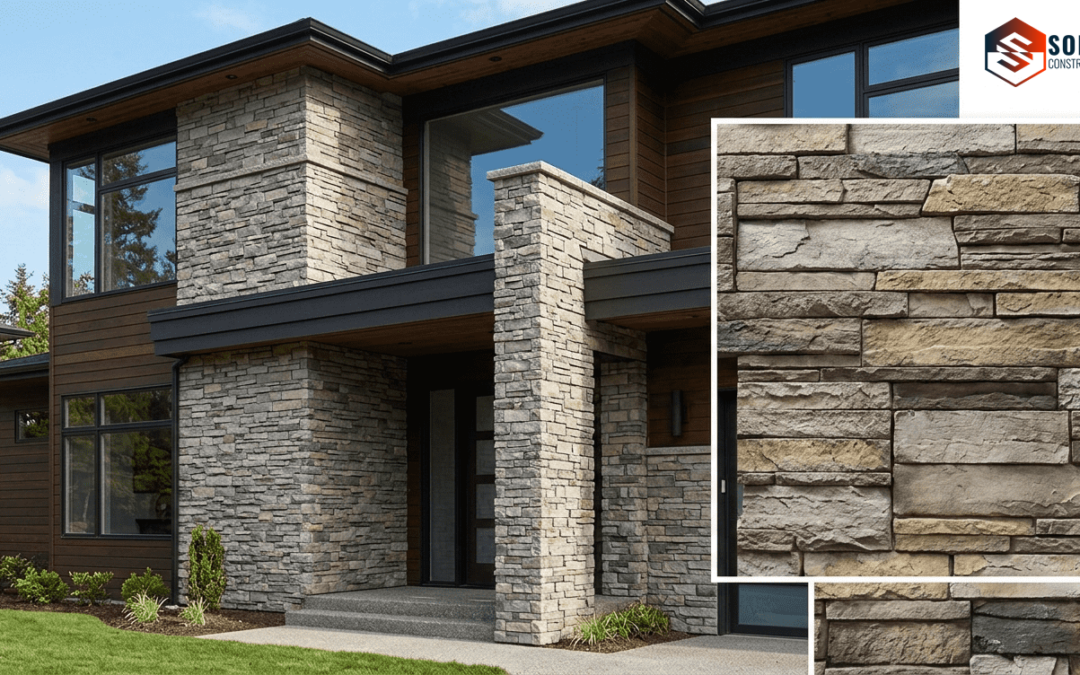
Versetta stone siding is a mortarless, cement-based manufactured stone panel from Westlake Royal Building Products. Each 8-by-36-inch panel covers 2 square feet, attaches with screws or nails, and comes in three styles. Material typically costs $17 to $21 per square foot before labor, delivery, and trim.
Homeowners who want hand-stacked stone without masonry labor usually land on this product, and their questions arrive in a predictable order: what it is, which style and color to choose, and what it costs. This guide answers all three using manufacturer specifications, distributor pricing, and the planning details that decide how a project actually goes.
Key Takeaways
- Versetta stone panels measure 8 by 36 inches and cover about 2 square feet, so net wall area divided by two gives your base panel count.
- The line includes three styles, Ledgestone, Tight-Cut, and Carved Block, across 11 colors.
- Material pricing commonly lands between $17 and $21 per square foot, and installed cost depends on wall complexity, substrate condition, and trim.
- Order 5 to 10 percent extra panels, and keep panels 2 inches above pavement and 4 inches above soil.
What Is Versetta Stone Siding and How It Works
Versetta stone siding is a cement-based stone veneer formed into pre-colored panels that install like siding instead of masonry. Westlake Royal Building Products makes the line, which was formerly sold under the Boral name. The manufacturer describes the panels as mortarless and hung with screws, with no scratch coat or metal lath required.
The material blends lightweight concrete, aggregate, water, and mineral oxide pigments. Because the pigment runs through the panel, a cut edge or scrape does not expose a mismatched core. Each panel carries a galvanized nailing flange along the top, and the next course covers the fasteners, so the finished wall shows stone instead of hardware.
That construction explains the pricing logic. There is no mason, no mortar mixing, no cure time, and no panel heavy enough to need equipment. The savings show up in labor and schedule rather than in the material line.
Versetta Stone Siding Features That Matter on a Real Wall
Spec sheets list features. Installers care about which ones change the outcome. These four do.
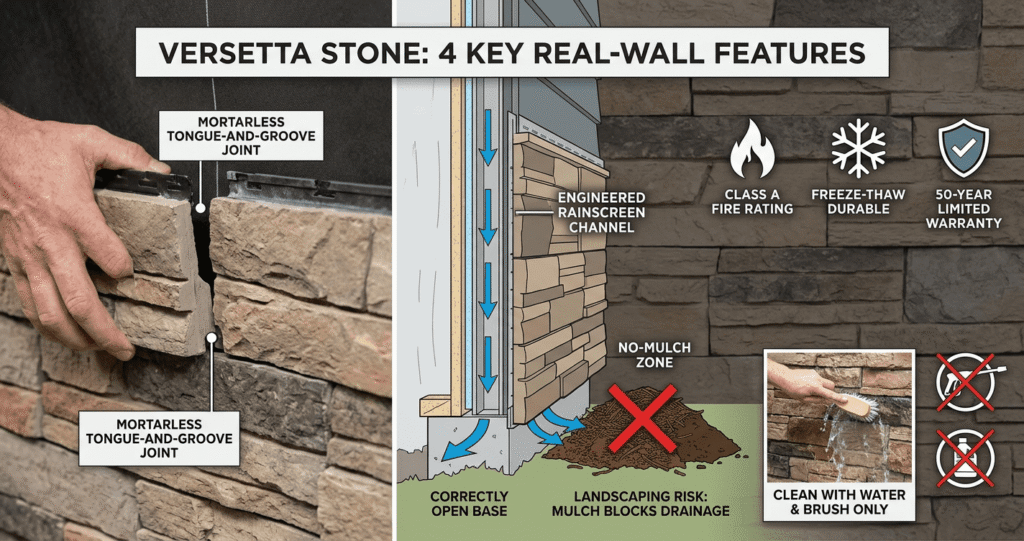
Mortarless Tongue-and-Groove Panels
The interlocking edges set spacing and alignment automatically, which is where the system earns its speed. Westlake’s brochure specifies four screws per flat panel. On long, uninterrupted walls, a crew moves fast. On walls broken up by windows, gables, and utility penetrations, cutting and fitting consume more of the schedule than hanging does.
Built-In Rainscreen Drainage
Each panel includes an engineered rainscreen channel that lets moisture drain down and out. That only works if the base stays open. Landscaping is the most overlooked threat: mulch or soil piled against the bottom course closes the drainage path and invites wicking.
Fire, Freeze-Thaw, and Warranty Performance
Westlake rates the siding non-combustible with a Class A fire rating and states it is tested for freeze-thaw durability across climate types. The product carries a 50-year limited transferable warranty. Read the warranty language before signing a contract, because installation conditions typically govern coverage. The manufacturer’s Versetta Stone FAQ is the best primary source for these claims.
Low Maintenance
Sealing is optional; Westlake allows a water-based silane or siloxane repellent. Routine cleaning needs only water and a nylon brush. The manufacturer warns against pressure washers and acid cleaners, and that rule matters because homeowners reach for both on stone. If you are unsure about applying a protective coating, learn whether Versetta Stone needs to be sealed before choosing a maintenance approach.
Versetta Stone Panel Dimensions and Coverage Math
Versetta stone panel dimensions are 8 inches tall by 36 inches long. Each panel covers about 2 square feet and weighs roughly 17 pounds, or about 8.5 pounds per square foot. Corner panels share the same 36-by-8-inch face size.
Estimating is where budgets slip, so here is the sequence on a sample wall:
- Measure gross wall area, then subtract windows and doors. Assume 500 square feet net.
- Divide by 2 for a base count of 250 panels.
- Add 10 percent for cuts and breakage, bringing the total to 275 panels.
- Round up to full cartons. Distributors commonly sell 36-panel cartons covering 72 square feet, so 275 panels means 8 cartons, or 288 panels.
Corner panels are ordered separately, so count them apart from flat panels. Ordering to net area with no waste factor is the classic mistake. The shortfall surfaces on the last wall and forces a second delivery.
Versetta Stone Siding Styles Compared
Versetta stone siding styles are not a two-way choice. The manufacturer offers three profiles, and the original two-style framing found in many articles leaves out Carved Block.
| Style | Texture | Best Suited For |
| Ledgestone | Traditional dry-stacked look with rugged, purposeful irregularity | Rustic, traditional, and craftsman homes |
| Tight-Cut | Refined, expertly fitted look with more uniform stones | Transitional and modern homes, and pairings with brick or stucco |
| Carved Block | Larger stones in varied sizes with a chiseled, split-face texture | Contemporary and commercial designs |
Style affects labor as much as appearance. Ledgestone’s greater variation forgives small layout drift. Tight-Cut’s uniformity leaves less room to hide a mis-set course, so it rewards careful leveling at the starter row. Carved Block panels are about 1.5 inches thick, which creates deeper shadow lines on larger faces.
Versetta Stone Siding Colors by Style
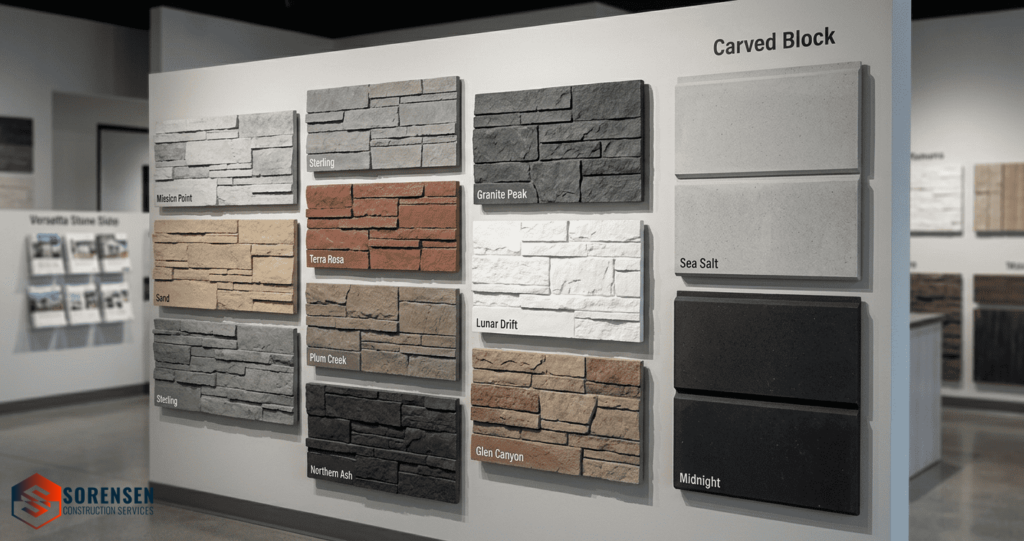
Versetta stone siding colors differ by profile, and availability varies by market. Westlake’s own guidance says product mix varies by location, so confirm stock with a local branch before falling for a shade.
| Style | Available Colors |
| Ledgestone and Tight-Cut | Mission Point, Sand, Sterling, Terra Rosa, Plum Creek, Northern Ash |
| Ledgestone and Tight-Cut (added 2025) | Granite Peak (dark gray), Lunar Drift (white), Glen Canyon |
| Carved Block | Sea Salt, Midnight |
Warm neutrals such as Sand and Mission Point suit earth-toned exteriors. Sterling and Northern Ash read cooler and pair well with gray siding. Granite Peak and Lunar Drift push toward contemporary palettes.
Westlake advises reviewing fan decks or physical samples, and that advice is sound. Printed and on-screen colors drift. Set samples against the actual roof, trim, and brick, then check them in morning and late-afternoon light before committing.
Versetta Stone Siding Cost and Manufactured Stone Siding Pricing
Versetta stone siding cost splits into material, delivery, and installation. Distributor and cost-guide listings put material at roughly $17 to $21 per square foot. For comparison, Fixr lists faux stone panels at $3 to $5 per square foot and cultured stone at $5 to $10, which places Versetta at the premium end of manufactured options.
Apply that range to the 576 square feet ordered in the example above and material alone runs about $9,800 to $12,100. Delivery is quoted separately, and one distributor cites 20 to 25 percent of material cost.
Published installed ranges for manufactured stone siding pricing vary widely. Fixr cites $16 to $21 per square foot for manufactured stone veneer, Angi cites $11 to $18, and HomeGuide spans $10 to $45 including labor. That spread shows why no generic figure should anchor a budget.
Factors That Move the Installed Price
- Wall complexity. Corners, gables, windows, and doors add cutting, flashing, and accessory pieces.
- Substrate condition. Panels fasten to any structurally sound surface. Rotted sheathing discovered at tear-off must be repaired first, and this is the line item that surprises homeowners most.
- Scope. An accent wall, wainscot, and full facade carry very different labor profiles.
- Existing cladding. Removing old siding adds demolition and disposal.
- Trim and flashing. Sills, caps, and transitions to other materials are priced separately.
An on-site assessment converts these variables into a firm number. Sorensen Construction Services provides free estimates for siding projects.
Installation Details That Protect the Investment
Cutting is straightforward with the right gear. Westlake recommends a circular saw, hand grinder, or chop saw with a 10-inch diamond segmented blade, plus a respirator, safety glasses, and gloves. If a wet saw is used, rinse slurry off the panel face immediately to prevent staining.
Pattern control matters visually. Boral’s technical guidance calls for random offset between courses so no repeating pattern appears. Pulling panels from several cartons while hanging helps blend variation across the wall.
Flashing deserves equal attention. Westlake notes that proper flashing and water diversion remain essential on any installation, and that is where inexpensive shortcuts create expensive callbacks. When planning your project, consider how much Versetta Stone costs to better understand the material’s upfront expense and budget for proper installation.
Versetta Stone Siding Versus Mortared Stone Veneer
Homeowners comparing quotes often see traditional mortared veneer next to Versetta, so the trade-offs deserve a direct look. Mortared veneer is set stone by stone with a scratch coat and metal lath behind it, then grouted. That process takes more trades, more cure time, and more weather sensitivity. Versetta replaces the wet steps with fasteners, which shortens the schedule and reduces the number of things that can go wrong on site.
Mortared veneer does win on one point: custom grout joints and stone-by-stone placement give a mason more design control. Versetta trades that control for consistency, speed, and a lighter wall load. For most residential accents and facades, that trade favors the panel system. For a one-of-a-kind hearth or a heritage restoration, a mason may still be the better call.
Where Versetta Stone Siding Fits Best, and Where It Does Not
The product shines on gable ends, entry columns, wainscot, foundation-height accent walls, fireplace surrounds, and full facades with simple geometry. It also works indoors, which makes matching an exterior accent to an interior feature wall easy.
It is not a structural material, and it is not the cheapest route to a stone look. Mass-produced panels repeat their patterns, so very large uninterrupted surfaces can read less organic than natural stone. For tight budgets or heavily detailed elevations, a blend of stone accents and a lower-cost siding often delivers better value per dollar. Before making a final decision, review the common problems with Versetta Stone siding to understand its potential limitations and determine if it is the right fit for your project.
Questions to Ask Before Signing a Versetta Contract
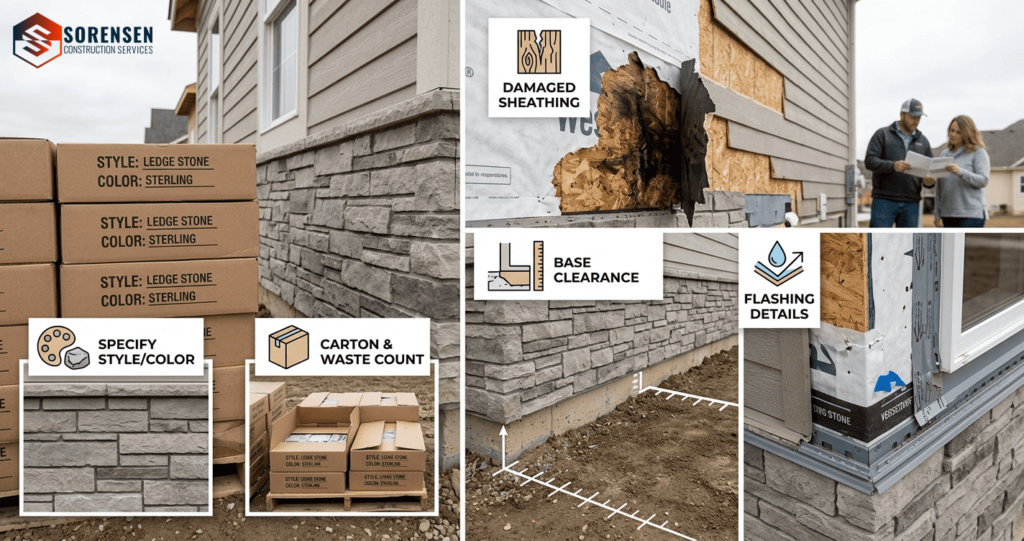
A good proposal answers these without hesitation. Ask which style and color are specified, and how many cartons and how much waste are included. Ask how the base clearances will be maintained after landscaping is finished, and what flashing details are planned at windows, rooflines, and transitions. Ask what happens if tear-off reveals damaged sheathing. Vague answers on any of these usually signal change orders later.
Conclusion
Versetta stone siding delivers convincing stone character through a panel system that trims labor, not material cost. Panel dimensions drive ordering, style drives texture, color drives curb appeal, and substrate and wall complexity drive the final bill. Plan for waste, protect the clearances, and verify color against real samples. Ready to upgrade your home’s exterior? Explore our rock, stone, and brick installation services and contact Sorensen Construction Services for a free, no-obligation estimate tailored to your project.
FAQ
- What is Versetta stone siding?
It is a mortarless, cement-based manufactured stone panel from Westlake Royal Building Products that installs with screws or nails. It delivers a hand-stacked stone look without mortar, a mason, or metal lath.
- How much does Versetta stone siding cost?
Material typically runs $17 to $21 per square foot at distributors, before delivery, trim, and labor. Installed cost depends on wall complexity and substrate condition, so an on-site estimate is the most reliable number.
- What are Versetta stone panel dimensions?
Each panel measures 8 inches by 36 inches, covers about 2 square feet, and weighs roughly 17 pounds.
- What colors does Versetta stone siding come in?
Ledgestone and Tight-Cut offer Mission Point, Sand, Sterling, Terra Rosa, Plum Creek, Northern Ash, Granite Peak, Lunar Drift, and Glen Canyon. Carved Block comes in Sea Salt and Midnight.
- What are the Versetta stone siding styles?
The three styles are Ledgestone, Tight-Cut, and Carved Block. Ledgestone is rustic and dry-stacked, Tight-Cut is more refined and uniform, and Carved Block is chiseled and suited to contemporary design.